
Mobility equipment
Mobility Scooters
New mobility scooters in both 4mph pavement and 8mph road classes, in a range of colours — with honest advice on which class suits the journeys you actually make.
What it does
New scooters, properly set up
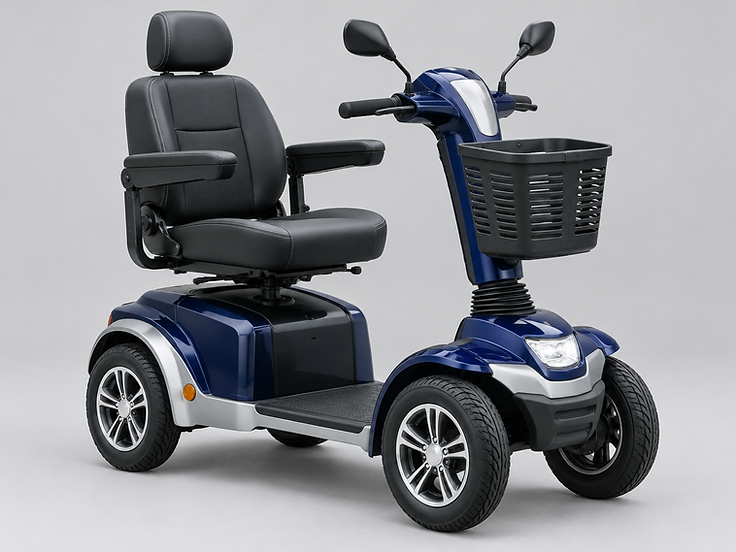
We supply new mobility scooters in the two classes that matter in the UK: 4mph pavement scooters and 8mph road-class scooters. Each one is assembled, charged and checked before it goes out, and we set the seat height, tiller angle and tyre pressures around you rather than around a showroom floor.
Pavement class (up to 4mph)
These are the scooters most people start with. They are limited to 4mph and are designed for pavements, paths and shopping centres. Many break down into a few manageable pieces, which also makes them a sensible choice if you live in a flat or need to lift the scooter into a car boot.
Road class (up to 8mph)
An 8mph scooter gives you a longer range, a more supportive seat and the option of using the road for short stretches. They are heavier and need more room to store and charge, so they tend to suit people with a driveway, garage or a sheltered spot beside the house.
What we ask before you choose
How far do you travel, and how often? What are the pavements like where you live? Where will the scooter live, and who will plug it in? If a smaller, lighter scooter will do everything you need, we will say so.
Who it’s suitable for
People who can get on and off the scooter independently, sit comfortably for the length of journey they have in mind, and have somewhere at home to store and charge it. A 4mph pavement scooter suits local trips and car transport. An 8mph road-class scooter suits longer, regular journeys and needs more storage space.
Who it’s not suitable for
Class 2 (4mph) scooters may not be used on the road. Class 3 (8mph) scooters may not use motorways, bus lanes or cycle-only lanes, and you cannot carry a passenger on either. Taking a scooter on buses or trains needs checking with the operator first. If your eyesight, reactions or balance have changed, please speak to your GP or an occupational therapist before choosing a faster scooter — we are not qualified to make that judgement for you.
Talk it through with us
No obligation, and no pressure to buy. We will tell you honestly whether this is the right route for you.
Unit 6, Business Park, Cholderton Road, Grateley, Grateley — we also visit you at home across Hampshire.
Pricing
Prices vary widely between a compact pavement model and a large road-class machine. Ring us and we will give you a straightforward price for the options that genuinely suit you, including any disability VAT relief you qualify for.
What to look for
- Battery range measured against real journeys, not laboratory figures
- Whether it breaks down for car transport, and the weight of the heaviest part
- Seat comfort and back support for the length of trip you have in mind
- Ground clearance for kerbs, gravel and garden paths
- Where the charging point sits, and how easy it is to reach
- Wing mirrors, indicators and lights on road-class models
How this helps day to day
- Get to the shops, the garden or the post box without waiting for a lift
- Keep your independence without relying on family for every short trip
- Most models carry a basket or bag hook, so shopping is easier to manage
- Charge it at home overnight — no fuel, and no licence or insurance for pavement-class use
Questions we are often asked
Yes, wherever it is practical. We will bring suitable models to your home so you can see how they handle your path, doorway and turning space. Trying a scooter in a shop tells you very little about how it will work in your own hallway.
A 4mph scooter is a Class 2 pavement scooter: it is for pavements, paths and pedestrian areas and may not be used on the road. An 8mph scooter is Class 3 road-class: it has a longer range and a more supportive seat, and it may use the road for short stretches, but not motorways, bus lanes or cycle-only lanes. Class 3 models are heavier and need more storage and charging space.
No licence, tax or compulsory insurance is required for a mobility scooter. Many owners take out insurance and breakdown cover anyway, and some hire companies and travel providers will ask about it. We can tell you what we know, but the decision is yours.
Not automatically. Some mobility scooters can be zero-rated for VAT where the product is designed or adapted for a person who is chronically sick or disabled and is supplied for that person's personal use. If you think you may qualify, tell us when you enquire — we will confirm the price you would actually pay and ask for a simple written declaration where HMRC's conditions are met.
VAT relief on eligible mobility equipment
Some mobility equipment can be zero-rated for VAT when it is designed or adapted for a person who is chronically sick or disabled, and when the equipment is supplied for that person’s personal use. The rules depend on both the product and your situation, so eligibility is not automatic.
If you think you may qualify, tell us when you get in touch. We will explain what HMRC requires, confirm the price you will actually pay, and ask for a simple written declaration before we supply the equipment. We will only apply the relief where the product and your circumstances meet HMRC’s conditions.
Related advice
Illustration to be added
Local Information
Mobility and Accessibility Around Andover: A Practical Guide
Surfaces, slopes and dropped kerbs around Andover and Grateley — what to think about before you plan a regular journey.
21 October 2026
Illustration to be added
Maintenance
Storing Your Mobility Scooter Over Winter
Where to store it, how to protect the battery, and the checks to make before you use it again in spring.
16 October 2026
Safety & Practical Advice
Pavement or Road? Where You Can Legally Use a Mobility Scooter
The rules for 4mph and 8mph scooters, where each class may go, and why pedestrians always come first on shared paths.
14 October 2026

No pressure, ever
Not sure what mobility solution is right for you?
Tell us what you are looking for and our team will be happy to discuss the options available — including what we would not recommend for your situation.
We visit customers at home across Hampshire, and there is never any obligation to buy.