
Mobility equipment
Walking Aids
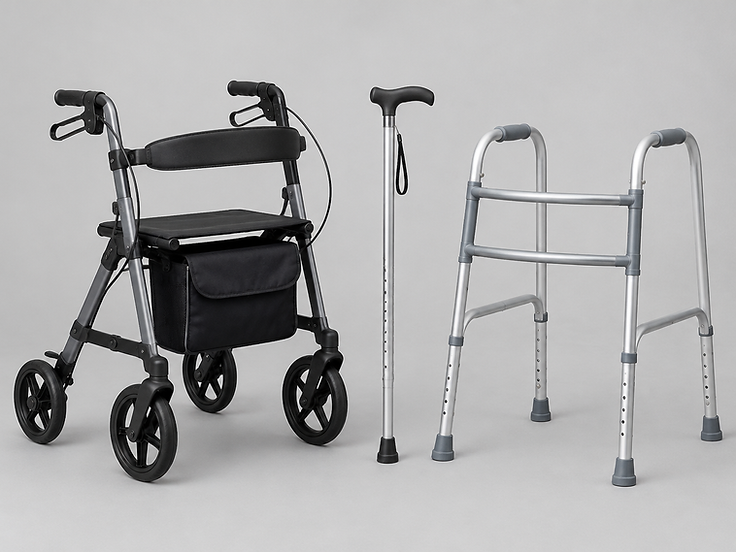
Walking sticks, frames and rollators that reduce the load on your body and improve balance — set up to suit your height and grip.
What it does
The right aid, at the right height
A walking aid only helps if it is set to your height. A stick that is too long pushes your shoulder up; too short and you stoop over it. We set handle heights with you standing, then check it again before you leave.
Sticks, frames and rollators
A single stick or a pair of sticks suits mild balance problems and takes some weight off a painful hip or knee. A walking frame gives the most support for short distances indoors. A four-wheeled rollator with a seat and a basket suits longer walks and lets you rest — and brakes are essential on any wheeled aid.
What suits your grip and strength
If your grip is weak, a moulded or larger handle can make a real difference, as can a forearm support trough. If you tire quickly, a rollator with a built-in seat turns a difficult walk into a manageable one.
Bring your own shoes
When you try an aid, wear the shoes you normally wear outside. Heights change with heel depth, and it is surprising how often that is the difference between comfortable and not.
Who it’s suitable for
People who can walk but want more stability, less pain or more confidence, and who can use an aid safely with either one or both hands. Rollators suit people who need to rest during a walk or who want to carry small items.
Who it’s not suitable for
Walking aids support balance — they do not correct it, and they are not a substitute for physiotherapy or a professional assessment of how you walk. If you are unsteady, falling or losing confidence, please speak to your GP or a physiotherapist first. Using an aid on stairs needs separate advice, and a standard walking aid is not suitable for that.

Talk it through with us
No obligation, and no pressure to buy. We will tell you honestly whether this is the right route for you.
Unit 6, Business Park, Cholderton Road, Grateley, Grateley — we also visit you at home across Hampshire.
Pricing
Walking aids are among the lower-cost items we stock. We will show you the difference between a basic stick and a properly supportive rollator, and let you decide.
What to look for
- Handle height adjusted to you, not to a chart
- Moulded, larger or forearm-support handles where grip is weak
- Brakes on all wheeled aids — checked before you take it home
- Folding or easy-dismantle options for the car boot
- Weight of the aid itself, if you will be lifting it in and out of a vehicle
- A seat on rollators, for resting part-way through a walk
How this helps day to day
- Walk further and for longer with somewhere to rest
- Reduce the load on a painful hip, knee or back
- Feel steadier on uneven pavements and dropped kerbs
- Carry a few shopping items or a handbag without juggling
Questions we are often asked
With your normal shoes on, the handle should sit at about the crease of your wrist when your arm hangs by your side. We set the height with you standing and check it again before you take the stick home, because a stick that is even a couple of centimetres out will pull at your shoulder or make you stoop.
If you have a painful hip or knee, one stick held on the opposite side to the painful joint usually gives the most support. If your balance is the main problem, a pair of sticks or a walking frame generally helps more. This is a question a physiotherapist answers best, and we will tell you when it is time to ask one.
A walking frame gives the most support but has to be lifted with each step, which is tiring over any distance and is really for use indoors. A four-wheeled rollator rolls along in front of you, keeps you steadier on longer walks and usually has brakes and a seat so you can rest. If you want to get out of the house, a rollator is normally the better answer.
Not a standard walking stick, frame or rollator — this needs separate advice and possibly a different solution such as a handrail or stairlift. Please do not use a normal walking aid on stairs, and speak to your GP, physiotherapist or occupational therapist about how to manage your staircase safely.
VAT relief on eligible mobility equipment
Some mobility equipment can be zero-rated for VAT when it is designed or adapted for a person who is chronically sick or disabled, and when the equipment is supplied for that person’s personal use. The rules depend on both the product and your situation, so eligibility is not automatic.
If you think you may qualify, tell us when you get in touch. We will explain what HMRC requires, confirm the price you will actually pay, and ask for a simple written declaration before we supply the equipment. We will only apply the relief where the product and your circumstances meet HMRC’s conditions.
Related advice
Illustration to be added
Local Information
Mobility and Accessibility Around Andover: A Practical Guide
Surfaces, slopes and dropped kerbs around Andover and Grateley — what to think about before you plan a regular journey.
21 October 2026
Illustration to be added
Maintenance
Storing Your Mobility Scooter Over Winter
Where to store it, how to protect the battery, and the checks to make before you use it again in spring.
16 October 2026
Safety & Practical Advice
Pavement or Road? Where You Can Legally Use a Mobility Scooter
The rules for 4mph and 8mph scooters, where each class may go, and why pedestrians always come first on shared paths.
14 October 2026

No pressure, ever
Not sure what mobility solution is right for you?
Tell us what you are looking for and our team will be happy to discuss the options available — including what we would not recommend for your situation.
We visit customers at home across Hampshire, and there is never any obligation to buy.